Do you remember that feeling when AI first became undeniable? That cold pit in your stomach. The whispers in the breakroom. The late-night thoughts: Is my skill set obsolete? Is everything I've built suddenly worthless?
"I felt it. That paralyzing 'AI Anxiety.' It was real, and it was terrifying."
But I made a choice. I decided I wasn't going to be paralyzed. If this wave was coming to wash everything away, I was going to learn how to surf it faster than anyone else.
I dove in. Deep.
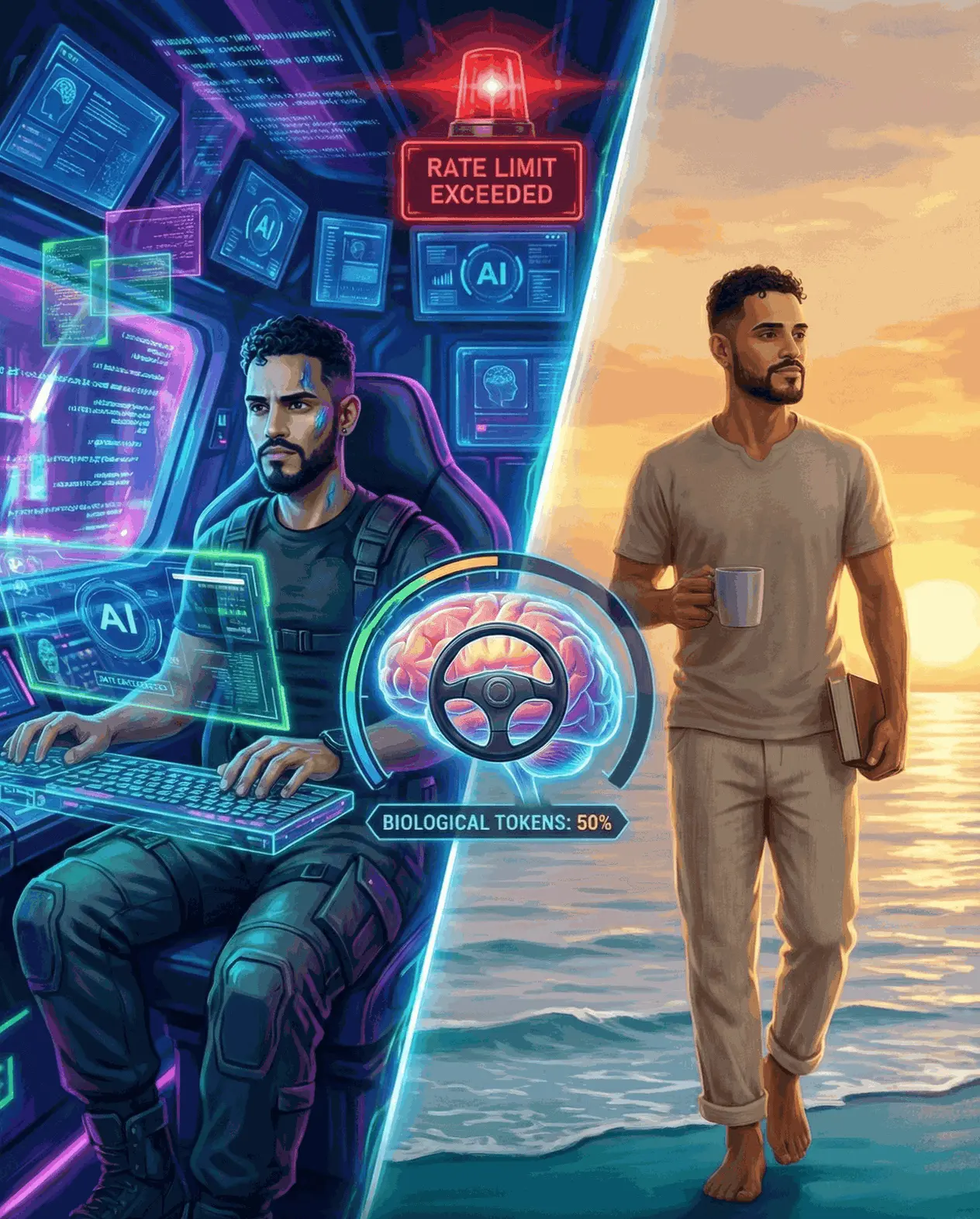
Today, I don't have anxiety anymore. I don't have time for it. My reality now is 16 to 18-hour days, staring at three monitors with 12 to 15 different AI chat sessions running simultaneously. I'm using advanced command-line tools, orchestrating complex workflows, and pushing these systems to their absolute breaking point.
I cured the anxiety, but I found a new, unexpected challenge. If you want to truly adapt to this new world, you need to know what happens when you go past the fear and enter the "Deep Dive."
🚀 The Shift: From Paralysis to Hyper-Speed
When you decide to embrace AI completely, the first thing you feel is an incredible rush of power. Suddenly, you aren't just one person. You are an orchestrator. You are the conductor of a super-intelligent symphony.
- Window 1: Architecting a complex business strategy.
- Window 2: Rewriting an entire codebase.
- Window 3: Brainstorming fifty blog topics for next campaign.
I'm doing the work of an entire department, all before lunch. The fear of being replaced vanishes because you realize: The machine can't run without me telling it what to do. You feel like you've upgraded your own brain.
It becomes addictive. You enter a dopamine loop: have an idea, prompt the AI, get instant results, get a better idea, prompt again. You feel like you are finally keeping pace with the future.
🛑 Hitting the Wall at 11 PM
But here is the dirty secret of the "Deep Dive" that nobody talks about.
Around 11:00 PM almost every night, something happens. The systems I use—the most advanced AI models on the planet—start throwing up errors. They tell me I've hit my "rate limits, out of Tokens." I have literally exhausted the machine's capacity to keep up with me for the day.
And that’s when I realize: I’m exhausted too.
My brain feels like a web browser with 500 tabs open, and the fan is spinning so fast the laptop is about to lift off the desk. I realized I hadn't truly "adapted." I had just traded anxiety for adrenaline. I was trying to out-compute a computer using biological hardware that needs sleep, food, and time to decompress.
I was winning the sprint, but losing my mind.
🧠 True Adaptability: The Human Element
If my journey into the deep end taught me anything, it's this: Adaptability isn't about how fast you can type prompts. It's about knowing when to stop.
If you are looking to integrate AI into your life and career without burning out, here are the three pillars of sustainable adaptation:
1. 🧭 You Are the Steering Wheel, Not the Engine
In the beginning, I tried to do everything the AI suggested. Now, I realize my value isn't in generating the most text; it's in having the taste and judgment to know what is good. The AI is a Ferrari engine, but if you don't steer it, it just crashes into a wall at 200 mph. Your human intuition is still the most valuable asset in the room.
2. 🔋 Respect Your "Biological Tokens"
The AI models have limits on how much information they can process each day. So do you. We have "mental energy tokens." If you spend them all before noon responding to low-level tasks, you have nothing left for high-level strategic thinking when it counts. Protect your mental energy fiercely.
3. 🌲 The Power of the Analog Break
You cannot synthesize what you've learned while staring at the screen that taught it to you. The greatest moments of clarity I have now don't come during the 18th hour in front of Gemini. They come when I walk away, go outside, or talk to an actual human being. The analog world is where you process the digital output.
🌌 The New Frontier
We are the first generation of AI pilots. We are flying at Mach 10 without a flight manual. The G-force is real, and the thrill of speed is incredible.
Don't let the anxiety paralyze you. Dive in. Learn these tools. They are magnificent leverage for your creativity and ambition. But remember this as you dive deep:
"The plane can fly forever. The pilot needs to sleep."
Adaptability isn't just about turning the machine on. It's having the wisdom to know when to turn it off.
Are you struggling with AI saturation? Contact Me or check out my other deep dives on Coqui.Cloud.

Surviving the Speed