
For the past decade, the healthcare industry has been trapped in a vicious cycle of administrative waste. Despite massive capital injections into Electronic Health Records (EHR) and the passage of the HITECH Act and the 21st Century Cures Act, the actual patient experience at intake has not changed in thirty years.
You walk into a clinic. They hand you a 15-page clipboard. You are forced to rely on pure memory to regurgitate two decades of complex medical history, prescriptions, and surgical dates in a 15-minute window.

This is not just an inconvenience. It is a dangerous clinical bottleneck that leads to egregious transcription errors, downstream billing denials, and what the industry calls the "intake penalty."
Recently, the federal government drew a line in the sand. With the release of the "Kill the Clipboard" Policy Roadmap (authored by Leavitt Partners) and the subsequent White House/CMS announcements on the Health Tech Ecosystem RFI, the mandate is clear: the United States must permanently eliminate manual intake administrative waste through modernized FHIR interoperability.
But federal policy and Request for Information (RFI) documents don't write code. They map the vision, but they require the private sector to build the actual architecture.
Well before the government published this latest roadmap, I spent two years independently researching this exact systemic failure. For the last 7 months, I locked in and engineered the functional codebase to execute it.
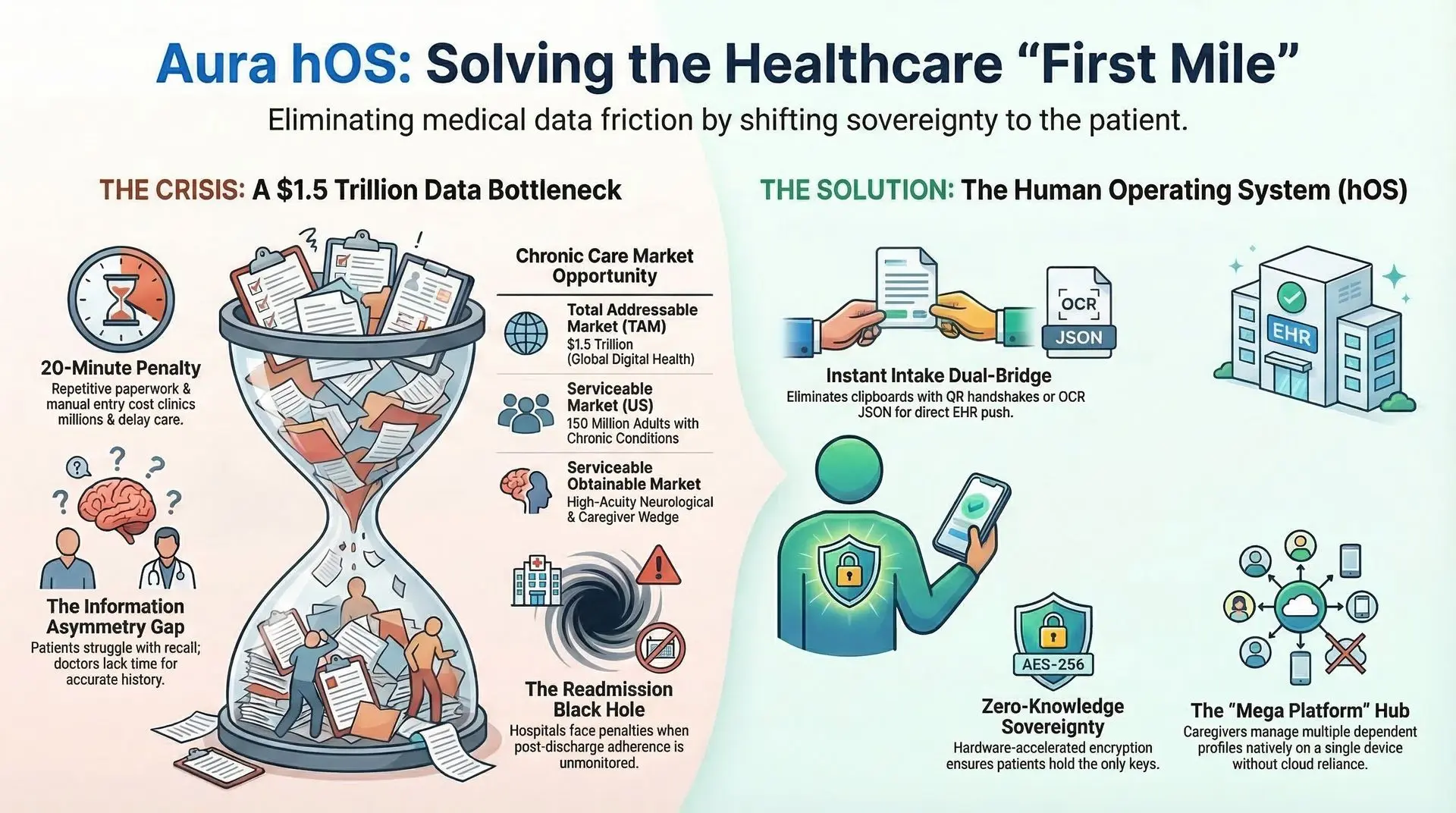
The Core Problem with Legacy "Solutions"
Before we could solve the CMS Category IV patient-facing app mandate, we had to analyze why current solutions fail. Most "app-based" intake systems attempt to digitize the clipboard by routing patient data to centralized third-party clouds.
This approach creates a massive, catastrophic vulnerability. The exact moment an external app holds patient health data on a centralized server before passing it to the hospital, it triggers severe FTC HBNR (Health Breach Notification Rule) legal liabilities and creates a highly lucrative honeypot for ransomware attacks.
We needed to build a system that killed the clipboard without creating a centralized data lake.
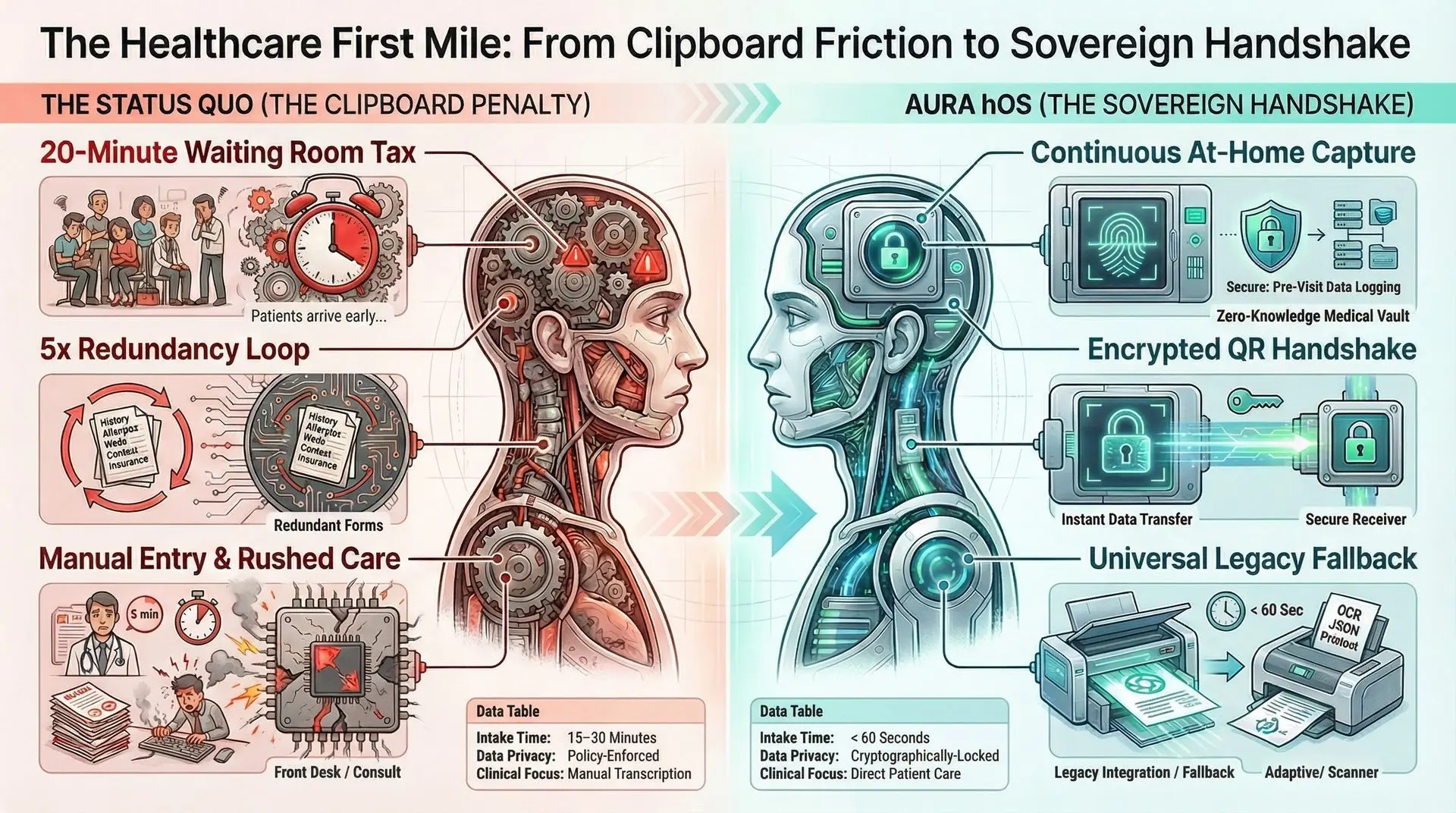
The Solution: Zero-Knowledge Edge Routing
To successfully execute the CMS mandate without inheriting centralized cloud liability, I engineered Aura hOS — a zero-knowledge routing infrastructure that structurally reorganizes how clinical telemetry moves from patient to provider.
Here is how Aura hOS architects the "Kill the Clipboard" initiative from the ground up:

1. Local FHIR Compilation (The Edge)
Aura hOS operates completely as an Edge computing vault natively on the patient's mobile device. It parses, formats, and translates the patient's medical history into rigid, standardized FHIR Structured Payloads natively inside their pocket. The data is never aggregated to a centralized third-party cloud.

2. The 2-Second Secure QR Handshake
When the patient enters the clinic, there is no paperwork, no API calls to a vulnerable intermediate cloud, no manual data entry for reception. The Aura hOS architecture bridges the structured payload directly from the patient's phone to the provider's triage dashboard via a 2-second encrypted QR handshake.

3. Absolute Data Sovereignty and Equity
By bringing the intake process out of the waiting room and into the localized digital environment, we completely dismantle the linguistic and cognitive barriers that disproportionately impact marginalized communities. Dyslexia, language barriers, and memory gaps no longer dictate the quality of care a patient receives.
From Policy to Production
The "Kill the Clipboard" initiative is the most important interoperability push of this decade. It correctly identifies that TEFCA modernization, digital identity, and administrative burden reduction are the only ways to save the American healthcare system.
But a blueprint requires a builder.
While policy advisors were writing the roadmap to accelerate innovation, I was engineering the functional codebase to execute it. Aura hOS is no longer a concept — it is a live Alpha architecture actively demonstrating that open-source, zero-knowledge interoperability is the only mathematically viable way to eliminate the waiting room penalty.
We now have the federal mandate. We now have the technical architecture. It is time for hospitals and enterprise integrators to end the era of the clipboard.
As the founder of the Humanos Foundation and a Systems Architect specializing in Zero-Knowledge infrastructure and CMS Interoperability — to see the full architectural breakdown of Aura hOS, visit aurahos.io/whitepaper.
Continue the Series:
Architecting the Aura Human Operating System ➔
The Poison Pill Architecture — Zero-Knowledge Security ➔
Pub/Sub Fan-Out Architecture for LLM Multi-Agent Swarms ➔
The 3,000-Hour Sprint — Architecting Aura hOS with the Centaur Model ➔
Humanos Foundation — The Mission Behind the Architecture ➔



